
Why Your Chopping Board Could Be Dirtier Than Your Toilet Seat
Most of us scrub the board, rinse it, and call it clean. Food-safety researchers say the real problem is the part a sponge can never reach.
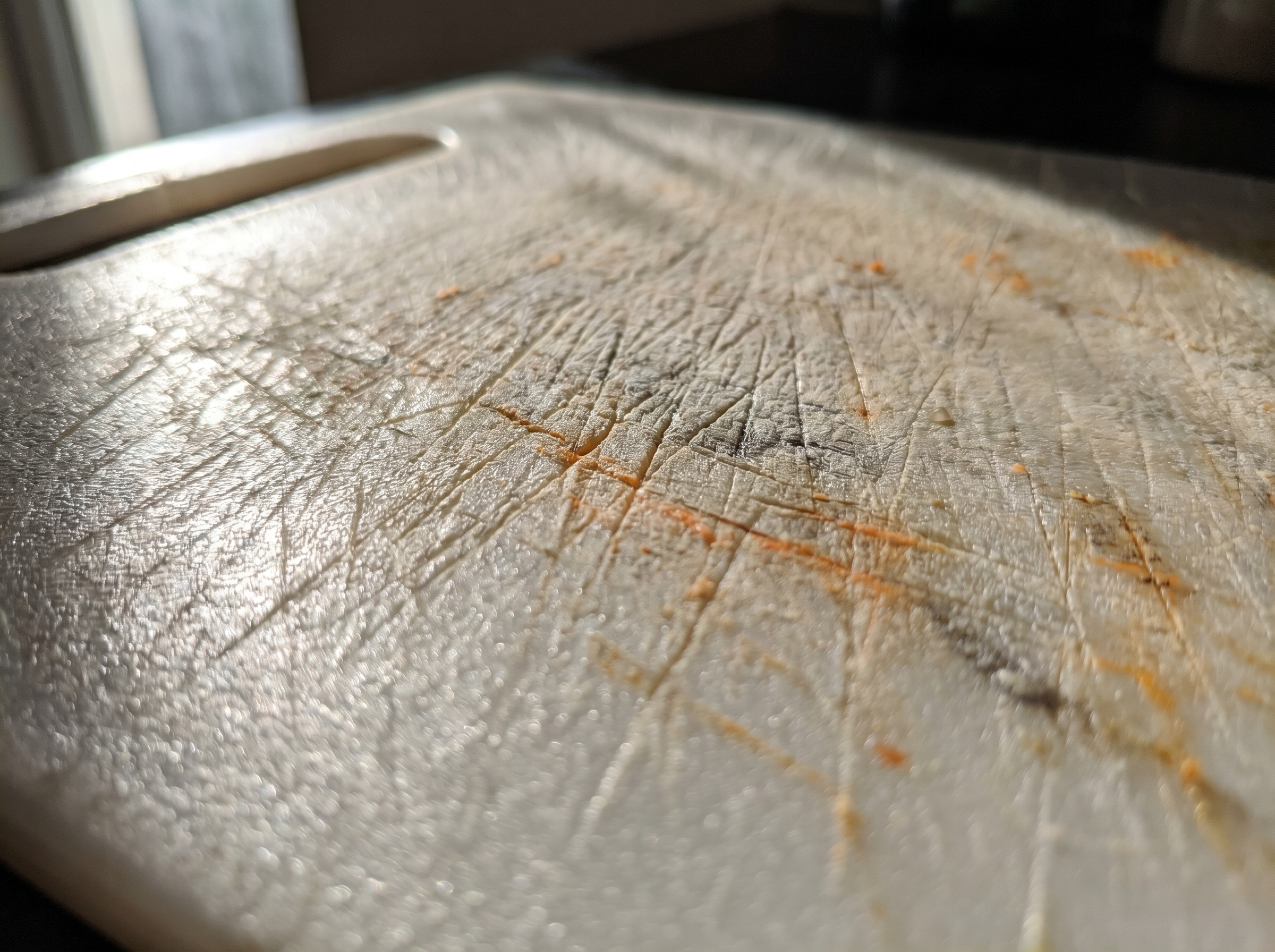
Every cut leaves a groove. Those grooves are where the trouble hides.
Margaret had cooked in the same kitchen for thirty years. Spotless benchtops. Tea towels washed twice a week. She was proud of it. So when her daughter mentioned that the old plastic chopping board might be the dirtiest thing in the house, Margaret laughed it off.
Then she picked it up and held it to the window light. The surface she scrubbed after every meal was covered in fine, dark knife lines. Hundreds of them. Some deep enough to catch a fingernail. And in those lines sat tiny flecks of who-knows-what, from years of chicken, onion, garlic and raw meat.
She had washed that board thousands of times. She had never once cleaned inside the cuts. Because you can't.
The part of your board you can never wash
Here is what most people never think about. A chopping board does its job by being cut. Every slice of the knife carves a tiny groove into the surface. Over months and years, those grooves add up to thousands of little channels.
On a smooth new board, a wash gets everything. On a scarred old one, the sponge glides straight over the top of the grooves and never reaches the bottom. Food, moisture and bacteria settle down inside where soap and water simply do not go.
It gets worse with the two materials almost every Australian kitchen relies on.
Plastic feels hygienic because it looks clean and goes in the dishwasher. But plastic is soft. Knives carve deep into it fast, and once those grooves form, they trap bacteria and hold it. Studies going back decades have found used plastic boards can hold more bacteria after washing than wood.
Wood looks natural and kind to knives, but it is porous. It drinks up moisture, juice from raw meat, and the bacteria that come with them. It can crack, and every crack is a new hiding place. You cannot put it in the dishwasher without ruining it, so it rarely gets a deep clean at all.
So where does the toilet seat come in?
It sounds like a scare line, but it traces back to real research. Food-hygiene scientists who swab household surfaces have repeatedly found that the average kitchen chopping board carries far more bacteria than the average toilet seat. One widely reported finding put it at around 200 times more.
The reason is not that toilets are magically clean. It is that we treat them as dirty, so we scrub them with strong cleaners often. We treat the chopping board as clean, so it gets a quick rinse and goes back in the drawer, grooves and all, ready for tomorrow's dinner.
What the research keeps finding
Used cutting boards can hold more bacteria per square centimetre than a toilet seat. Knife grooves shield bacteria from washing. Plastic and wood both develop these grooves quickly. The bacteria that matter most here, like Salmonella, E. coli and Campylobacter, are exactly the ones that come off raw meat and poultry.The fix is not cleaning harder. It is a surface that does not trap anything.
You can scrub a grooved board all day and not fix the grooves. The only real fix is a surface that does not gouge like plastic and does not soak like wood. For years there was no everyday option that did both. The good ones were either too soft, too porous, or too precious to actually use.
That is what makes the next part interesting. The material solving it is one Australians already trust for strength, just never expected to see in the kitchen.
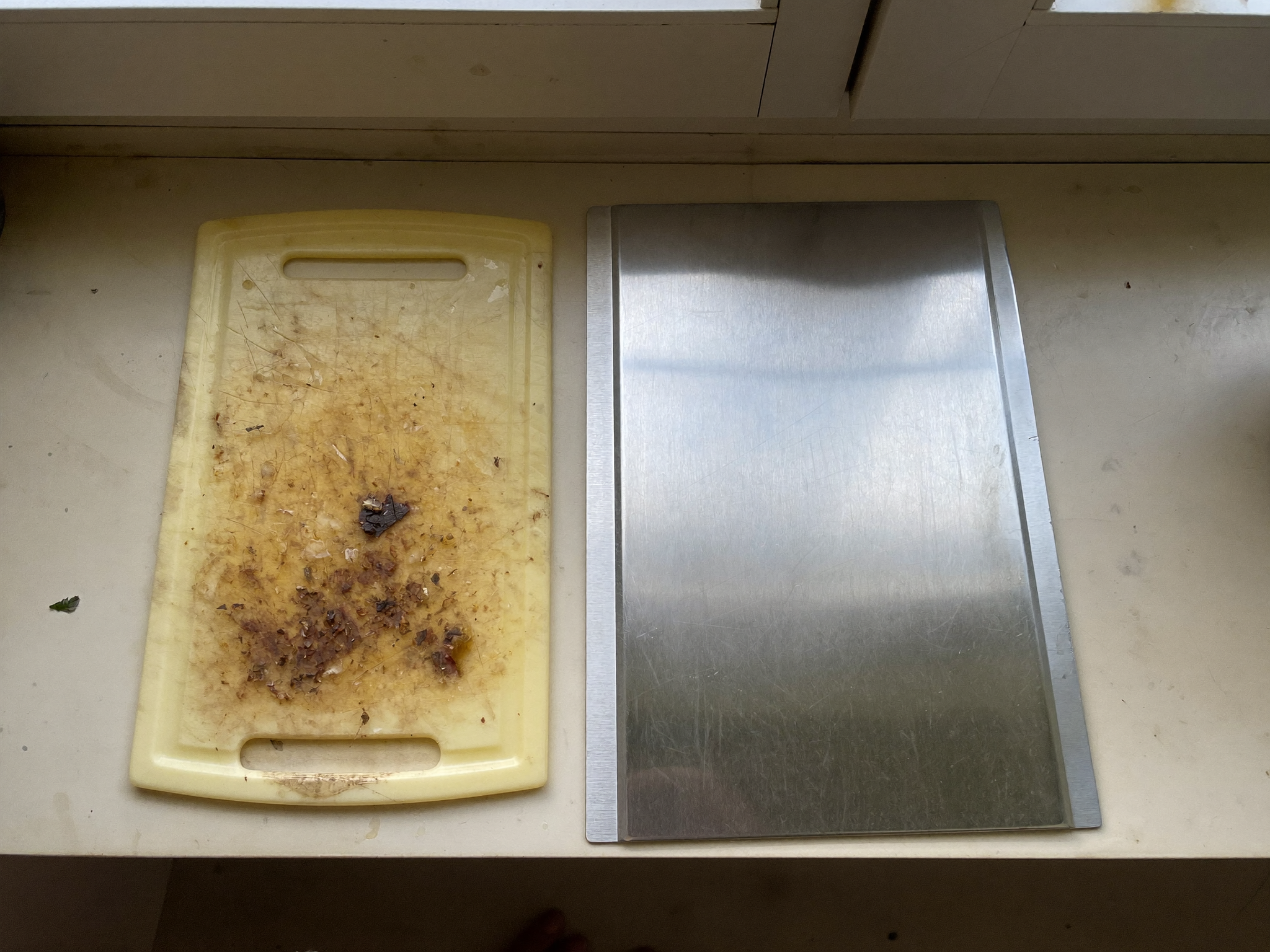
Same job, two very different surfaces. One you can never fully clean. One you can.
Why titanium changes the maths
Titanium is the metal used in aircraft, surgical implants and high-end tools. People trust it because it is famously strong and it does not rust. Prime Aussies took that same metal and made it into a solid chopping board, and it solves the groove problem at the source.
Titanium is non-porous. Liquid, juice and bacteria cannot soak in the way they do with wood. There is nothing to absorb.
Titanium is also far harder than plastic, so a knife does not carve deep channels into it. Without the deep grooves, there is no hidden ledge for bacteria to shelter in. A wipe actually reaches the whole surface, because the whole surface is right there on top.
And because it is solid titanium rather than a coating, there is nothing to chip, peel or wear away. It does not rust. It does not crack, warp or split. It will not stain or hold the smell of last night's garlic.
Plastic vs wood vs titanium, side by side
| Titanium★ Best | Plastic | Wood | |
|---|---|---|---|
| Non-porous (no soaking) | ✓ | ✗ | ✗ |
| Resists deep germ grooves | ✓ | ✗ | ✗ |
| No microplastics in food | ✓ | ✗ | ✓ |
| Won't crack, warp or split | ✓ | ✗ | ✗ |
| Won't stain or hold smells | ✓ | ✗ | ✗ |
| Dishwasher safe | ✓ | Sometimes | ✗ |
| Lasts a lifetime | ✓ | ✗ | ✗ |
A second reason people are switching: plastic in your food
The hygiene problem is the big one, but there is a quieter one. When you chop on a plastic board, the knife does not just scratch it. It shaves off tiny plastic particles, and some of those end up in your meal. Researchers have measured it. The more you cut, the more you swallow.
Titanium sheds nothing. There is no plastic to come off. What you cut is all you eat. For a lot of buyers over 55 who are already trying to eat cleaner, that alone is the tipping point.
"Will it blunt my knives?"
The most common question, and a fair one. Titanium is a firm surface, so the honest answer is to use it the way you would any firm board: let the knife do the work, keep it sharp, and hone it regularly. Plenty of owners report no real difference in day-to-day prep.
What owners say





One board. Built to last a lifetime.
Solid titanium. Non-porous, rust-proof, and impossible for grooves to hide in. Join 10,000+ Aussie kitchens that made the switch.
GET MY TITANIUM BOARDMargaret swapped hers a fortnight ago. The old plastic board went in the bin, grooves and all. She says the strangest part is how obvious it feels now. She spent thirty years cleaning the one thing in her kitchen she could never actually get clean.
The board she uses today, she will likely never replace.